Pulse Oximeter Buying Guide: Top Brands, Prices & Features You Should Check Before Buying
If you have ever searched for pulse oximeter price, you already know one thing — the options are endless and the prices jump around a lot. One shop sells it for 400 taka. Another shop, right next door, sells almost the same-looking device for 3,000 taka. So which one do you trust?
This confusion is common, and it is not your fault. Most sellers only talk about the price. They rarely explain what actually makes one oximeter better than another, or why the pulse oximeter price changes so much from shop to shop.
In this guide, we will walk through everything step by step — what a pulse oximeter really does, what a normal reading looks like, which brands are worth your money, and how to avoid wasting cash on a device that gives wrong numbers. By the end, you will know exactly what to look for the next time you check the pulse oximeter price in bd before buying one for your home or clinic.
Let’s get started.
What Is a Pulse Oximeter and Why Do You Need One?
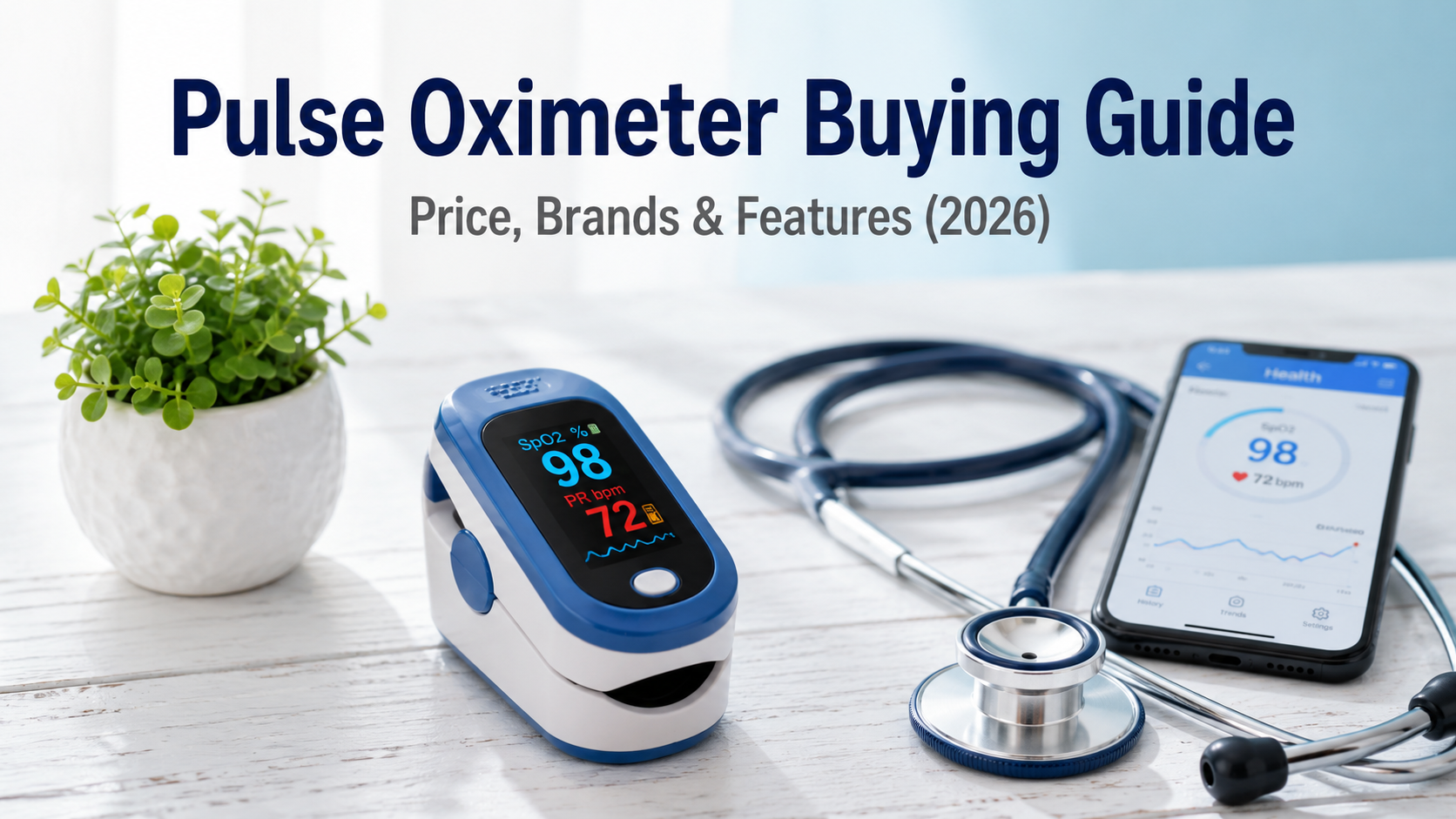
A pulse oximeter is a small clip-like device. You place it on your fingertip, wait a few seconds, and it shows two numbers on a tiny screen — your blood oxygen level (called SpO2) and your heart rate (pulse).
It works using light. The device sends a beam of light through your finger and measures how much of it gets absorbed by your blood. Based on that, it calculates how much oxygen your blood is carrying. No needles, no pain, no waiting for lab results.
People started paying close attention to this small gadget during the COVID-19 period, when doctors advised patients to check their oxygen level at home every day. But its use did not stop there. Today, it is a common household item, much like a thermometer or a blood pressure machine.
Before you compare pulse oximeter price across different shops, it helps to know who actually needs one:
- People with asthma or COPD (breathing problems)
- Elderly family members living alone
- Patients recovering from pneumonia or COVID
- Athletes tracking fitness levels
- New parents who want a home health kit ready
- Anyone with a heart condition
If any of these apply to your family, a pulse oximeter is a smart, low-cost investment. It is one of those devices you hope you never urgently need — but you will be glad you have it when you do.
What Is Pulse Oximeter Use?
Quick answer: A pulse oximeter is used to check the oxygen level in your blood and your heart rate, without drawing blood or visiting a hospital.
Doctors and nurses use bigger, hospital-grade versions during surgery, in ICUs, and while monitoring patients on oxygen support. At home, a smaller fingertip version is used for simple daily checks.
Here are the most common real-life situations where people use it:
- Checking breathing problems — If someone feels short of breath, a quick oximeter reading tells you if it’s serious enough to rush to a hospital.
- Monitoring recovery — After a lung infection or COVID, doctors often ask patients to track their SpO2 twice a day.
- Sleep apnea checks — Some wearable oximeters track oxygen dips during sleep.
- Fitness tracking — Runners and hikers at high altitude use it to check how their body is adjusting.
- General peace of mind — Many families simply keep one at home, the same way they keep a thermometer.
The device is genuinely simple. Clip it on, hold still for five seconds, read the number. That’s it. No training needed.
Pulse Oximeter Price in Bangladesh: What Should You Expect?
This is probably the reason you clicked on this article. Let’s be direct about it.
The pulse oximeter price in bangladesh depends heavily on three things — the brand, the display quality, and where you buy it from (pharmacy, online shop, or a medical equipment store). Here is a simple breakdown based on the current market:
| Category | Price Range (BDT) | What You Get |
|---|---|---|
| Unbranded / No warranty | ৳400 – ৳600 | Basic reading, accuracy not guaranteed, no after-sale support |
| Certified entry-level | ৳700 – ৳1,200 | Reliable accuracy, simple LED display, small brand warranty |
| Mid-range with OLED screen | ৳1,300 – ৳2,500 | Better display, auto shut-off, more stable readings |
| Advanced / clinical-grade | ৳2,500 – ৳5,000+ | Used in clinics, higher accuracy, memory storage, sturdy build |
Notice how the price of pulse oximeter almost doubles as you move from unbranded to certified models. That gap is not just marketing — cheaper sensors genuinely give less reliable readings, especially on people with cold hands or darker skin tones, where light-based sensors can struggle.
A quick tip: never pick the cheapest option just because the number looks small. A wrong reading during a real emergency is far more costly than the 500 or 600 taka you saved.
What Is the Price of an Oxygen Meter in Bangladesh?
Quick answer: An oxygen meter (another common name for a pulse oximeter) usually costs between ৳700 and ৳2,500 in Bangladesh for a reliable home-use model, though unbranded ones can go as low as ৳400.
People often use the term “oxygen meter” and “pulse oximeter” interchangeably, so if you searched for oximeter price in Bangladesh expecting a different device, don’t worry — you’re in the right place. They mean the same thing.
Local pharmacies, medical equipment shops, and online stores like Daraz, Rokomari, and dedicated medical supply websites all sell these devices. Prices can shift slightly depending on the season too — during flu outbreaks or dengue season, demand rises and prices sometimes creep up by a few hundred taka. Buying a little ahead of time, rather than during a health scare, usually saves money.
What Is a Normal Pulse Oximeter Reading?
Quick answer: A normal SpO2 reading is between 95% and 100% for a healthy person. Anything below 90% is considered a medical emergency and needs immediate attention.
Here’s a simple table to keep handy at home:
| SpO2 Reading | What It Means |
|---|---|
| 95% – 100% | Normal, healthy range |
| 91% – 94% | Mildly low, keep monitoring, consult a doctor if it stays here |
| Below 90% | Emergency — seek medical help right away |
| Below 80% | Severe — go to a hospital immediately |
Keep in mind, a single low reading is not always a disaster. Cold fingers, nail polish, or shaky hands can throw off the number for a moment. Always take two or three readings, a minute apart, before drawing any conclusion.
What Is the Normal Pulse Rate Using an Oximeter?
Quick answer: A normal resting pulse rate for adults is between 60 and 100 beats per minute. Athletes and very fit individuals may have a lower resting rate, sometimes even in the 40s or 50s.
The pulse rate shown on your oximeter is simply your heartbeat count per minute. It’s the second number on the screen, usually smaller than the SpO2 percentage.
| Age Group | Normal Pulse Rate (bpm) |
|---|---|
| Adults | 60 – 100 |
| Children (6-15 yrs) | 70 – 100 |
| Well-trained athletes | 40 – 60 |
| Elderly | 60 – 100 (can vary with health conditions) |
If your pulse rate is unusually high or low along with a low oxygen reading, that combination is a stronger warning sign than either number alone.
Is a 92% Oxygen Level Good?
Quick answer: No, 92% is considered low. It falls into the “mildly low” zone and should not be ignored, especially if it stays there for more than a few minutes.
A single reading of 92% right after waking up, or while your hand was cold, might just be a fluke. But if you check again and it’s still around 92%, that is your body telling you something is off. Rest, sit upright, take slow deep breaths, and check again after 10 minutes. If it does not improve, or if you also feel breathless, dizzy, or unusually tired, contact a doctor without delay.
This is exactly why owning a reliable device matters more than chasing the lowest pulse oximeter price you can find. A cheap, inaccurate device might show 95% when your real level is actually 91% — and that false comfort can be dangerous.
Can a Pulse Oximeter Check BP?
Quick answer: No, a standard pulse oximeter cannot measure blood pressure. It only measures oxygen saturation (SpO2) and pulse rate.
This is a common mix-up because both devices clip or wrap around your body and show numbers on a small screen. But they measure completely different things. Blood pressure needs a cuff that inflates around your arm to measure the force of blood against your artery walls — a pulse oximeter has no such mechanism.
Some newer smartwatches claim to estimate blood pressure using similar light-sensor technology, but these are still not considered medically accurate replacements for a proper BP monitor. If you need to track blood pressure, buy a separate digital BP machine — don’t rely on your oximeter for it.
Which Finger Is Best for a Pulse Oximeter?
Quick answer: The middle finger or index finger of your dominant hand usually gives the most accurate reading, since they tend to have better blood flow.
A few practical tips for getting the correct reading:
- Remove nail polish or fake nails before testing — dark colors can block the light sensor.
- Warm your hands first if they feel cold; poor circulation lowers accuracy.
- Sit still and rest your hand on a table instead of holding it in the air.
- Avoid testing right after exercise, smoking, or drinking coffee — these can temporarily raise your pulse rate.
- Wait at least 10-15 seconds for the reading to stabilize before noting the number.
Small habits like these matter more than people realize. A perfectly good device can still show a wrong number if it’s used carelessly.
What to Look for When Buying an Oximeter
Since you’re already comparing pulse oximeter price bangladesh options, here is a checklist to run through before you pay for one:
| Feature | Why It Matters |
|---|---|
| Accuracy certification (CE/FDA marks) | Confirms the device meets basic safety and reading standards |
| Display type (OLED vs LED) | OLED screens are easier to read, even in low light |
| Auto shut-off | Saves battery when not in use |
| Display orientation (auto-flip) | Useful for elderly users reading it upside down |
| Battery type | AAA batteries are cheaper to replace than rechargeable ones for most home users |
| Warranty | At least 6-12 months from a known local seller |
| Build quality | A snug, comfortable clip that doesn’t pinch |
| Brand reputation | Established brands generally have more consistent quality control |
Avoid buying purely because a shop is offering a heavy discount on the pulse oximeter price. Ask if the device comes with a warranty card and check a few customer reviews first, especially for online purchases.
Which Pulse Oximeter Is Best?
There’s no single “best” pulse oximeter for everyone — it depends on whether you need it for home use, sports, or clinical purposes. That said, a few brand categories consistently perform well in the Bangladeshi market.
| Brand Type | Best For | Approx. Price (BDT) |
|---|---|---|
| Jumper (JPD series) | Home use, reliable readings | ৳1,200 – ৳2,000 |
| RFL Getwell | Budget-friendly home use | ৳1,000 – ৳1,500 |
| Medical-grade clinical brands | Clinics, hospitals, frequent monitoring | ৳2,500 – ৳5,000+ |
| Local unbranded imports | Occasional, casual checks only | ৳400 – ৳800 |
If you only need it for occasional home checks, a mid-range certified brand is usually the sweet spot. If you’re a caregiver monitoring someone daily, spend a bit more for a clinical-grade option — the extra accuracy is worth it.
How to Use a Pulse Oximeter Correctly
Even the best device gives wrong results if used the wrong way. Follow these simple steps:
- Turn on the device and make sure the batteries have enough charge.
- Remove any nail polish or fake nails.
- Rest your hand on a flat surface, palm facing up.
- Clip the device onto your middle or index finger, making sure it sits snug.
- Stay still and avoid talking for about 10-15 seconds.
- Read the SpO2 percentage and pulse rate once the numbers stop changing.
- Record the reading if you’re tracking it over several days.
Simple as it sounds, most reading errors happen from movement or a poorly fitted clip — not from a faulty device.
Common Mistakes People Make When Buying
- Chasing the lowest price only — A device priced far below the market average is often unreliable.
- Ignoring the warranty — Without one, you have no support if the device stops working in a month.
- Buying from unknown online sellers — Always check reviews and seller ratings first.
- Not checking the display type — A dim LED screen is hard to read for elderly family members.
- Assuming all oximeters are the same — Sensor quality varies a lot, even within similar price ranges.
Taking an extra five minutes to compare before you buy can save you from returning a faulty unit later.
Conclusion
A pulse oximeter is a small device, but it plays a big role in keeping your family safe — especially if someone at home has a breathing condition, a heart issue, or is recovering from an illness. The pulse oximeter price can range anywhere from 400 to 5,000 taka, but the number alone shouldn’t be your only guide. Look at accuracy certification, display quality, warranty, and brand reputation before deciding.
Whether you’re comparing the pulse oximeter price in bd at a local pharmacy or browsing an online medical store, use this guide as your checklist. A slightly higher upfront cost for a certified, reliable device is almost always worth it in the long run.
If you’re planning to buy one soon, take a moment to check current listings, compare two or three sellers, and read recent buyer reviews before making your final choice.
FAQ Section
1. How often should I check my oxygen level at home?
For healthy people, there’s no need to check daily. But if you have a breathing condition or are recovering from illness, checking once or twice a day is a good habit.
2. Do pulse oximeters need calibration?
Most home-use oximeters don’t need manual calibration, but they should be replaced or serviced if you notice consistently odd readings over time.
3. Can nail polish affect the reading?
Yes. Dark or thick nail polish can block the light sensor and give an inaccurate reading. Always remove it before testing.
4. Is a hospital-grade oximeter better than a home one?
Hospital-grade devices are generally more accurate and durable, but they cost more and aren’t necessary for casual home monitoring.
5. Can children use a pulse oximeter?
Yes, but choose a smaller, child-friendly clip size for accurate readings, since adult clips may not fit small fingers properly.
6. How long do pulse oximeter batteries last?
Depending on usage, standard AAA batteries can last several months with occasional daily use.
7. Does cold weather affect oximeter readings?
Yes. Cold fingers reduce blood flow, which can lower the reading temporarily. Warm your hands before testing for accuracy.
8. Where is the best place to buy a pulse oximeter in Bangladesh?
Trusted pharmacies, certified medical equipment stores, and reputable online marketplaces are your safest options — always check for a warranty.
9. Can I use a pulse oximeter on my toe instead of a finger?
Some models allow this, but fingers generally give more accurate and stable readings for most users.